
RO e-Transport: 3 Key Checks for Transport Companies
The RO e-Transport system has become an important obligation for companies carrying out road transport of monitored goods on Romanian territory. After several periods during which sanctions for the technical obligations related to GPS monitoring were suspended, these sanctions have become applicable as of 1 January 2026, unless a new legislative postponement is introduced.
For carriers, the key issue is no longer only the generation of the UIT code, but also the ability to prove that the transport-related data was correctly transmitted to ANAF throughout the route.
The RO e-Transport system applies to road transports carried out with vehicles with a maximum technically permissible mass of at least 2.5 tonnes, when the transported goods exceed a total gross weight of 500 kg or a value of RON 10,000, for at least one consignment of goods. For domestic transport, the obligation concerns high fiscal risk goods established by OPANAF 802/2022, as subsequently amended. For international transports monitored through RO e-Transport, the obligation applies regardless of the nature of the goods, provided that the legal conditions regarding the vehicle and the consignment of goods are met.
Before the transport begins, the company must declare the necessary data in the RO e-Transport system and obtain the UIT code. The declaration can be made in two ways:
Manually, through the platform made available by the authorities, by an operator within the company.
Automatically, through API integration with internal systems, so that the transport data is transmitted automatically and the UIT code is generated without repetitive manual input.
TELL Security Systems is an accredited RO e-Transport operator and provides its customers with the data transmission service to ANAF free of charge, both in the manual version and in the automated version.
1. Does your GPS actually transmit data to ANAF?
It is not enough for the vehicle to be equipped with GPS. For RO e-Transport compliance, positioning data must be transmitted to ANAF throughout the monitored route.
In practice, the difference between “we have GPS on the truck” and “the data reaches ANAF correctly” is essential. A GPS system that works internally does not automatically guarantee that the authorities receive the required data in the format and flow requested.
A case publicly reported in February 2026 indicates a RON 20,000 fine applied to a carrier for non-compliance regarding GPS monitoring associated with a UIT code. The situation shows that the mere existence of GPS equipment is not enough if the effective transmission of data to the RO e-Transport system cannot be demonstrated.
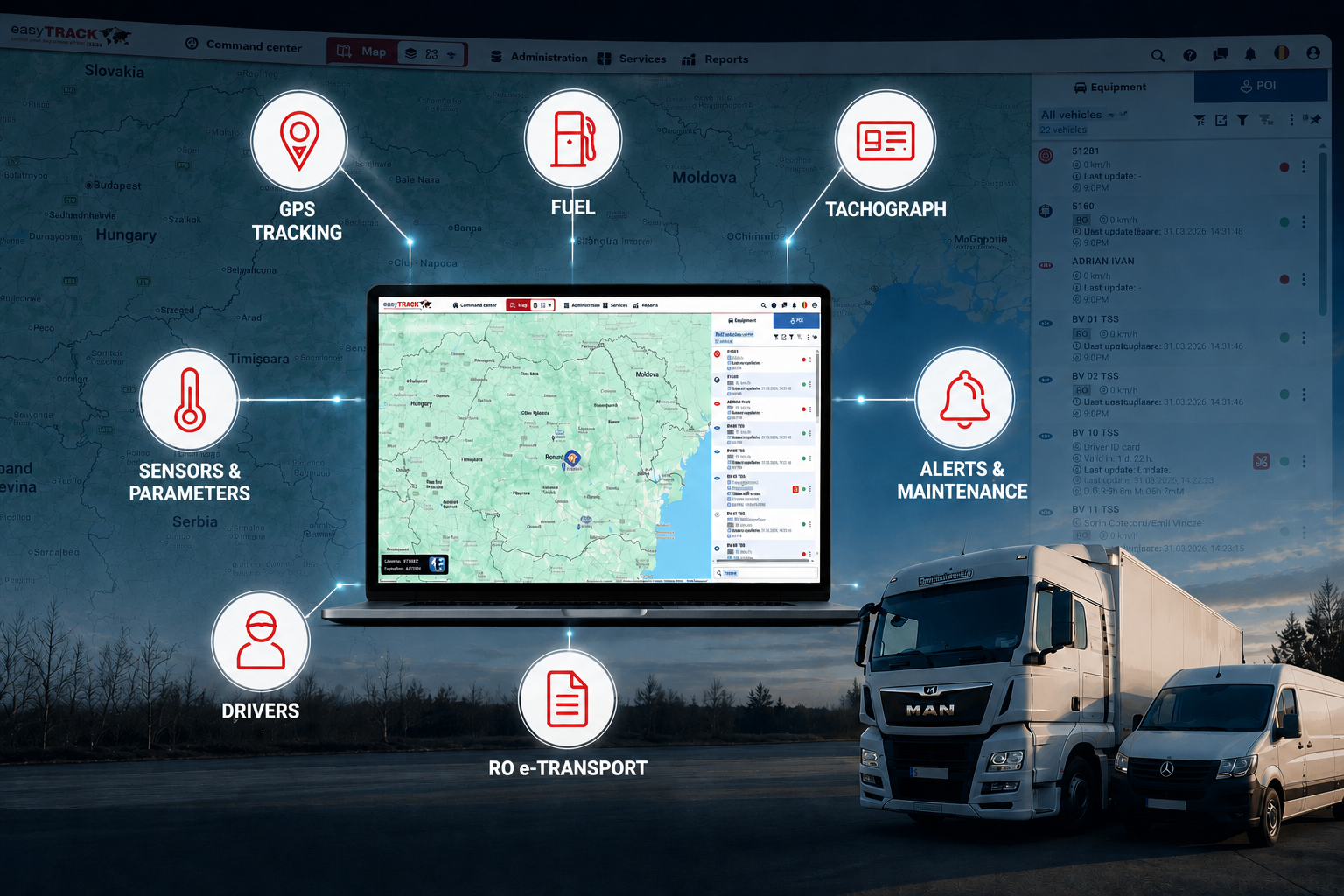
What easyTRACK does: it ensures the automatic and continuous transmission of GPS coordinates to ANAF and the association of UIT codes with the monitored vehicles in the platform. The flow is automated, without repetitive manual intervention and without dependence on the driver’s actions for each operational stage.
2. Can your dispatcher see if the transmission has been interrupted?
Another critical area is monitoring transmission continuity. If the vehicle loses communication and the dispatch team receives no alert, the company may only find out about the issue during an inspection.
In RO e-Transport, what matters is not only the existence of the UIT code, but also the consistency of the data transmitted throughout the route. A communication interruption, an incorrect association between the vehicle and the UIT code, or monitoring that does not cover the relevant transport interval may generate inconsistencies in the data available to the authorities.
GPS monitoring must also be managed correctly until the end of the transport. The positioning device must be stopped only after the goods have been delivered to the declared location or after leaving the national territory, as applicable. Incorrect management of the monitoring interval may create overlaps or discrepancies between successive transports carried out by the same vehicle.
What easyTRACK does: it sends real-time alerts for communication interruptions and data transmission errors. This allows the dispatcher to intervene quickly, before a technical or operational issue becomes a sanction risk.
3. Do you have verifiable evidence for each transport?
In the event of an inspection, the company must be able to demonstrate not only that it generated the UIT code, but also that the transport-related data was properly managed. The authorities can verify the existence of the code, its correlation with the vehicle, and the transmission of positioning data throughout the monitored route.
This is why carriers need to have access to clear, verifiable, and easy-to-present reports. Without a complete history, the company may find itself unable to prove compliance, even if the transport was carried out correctly from an operational point of view.
For many companies, the real challenge is not only compliance at the moment of declaring the transport, but also keeping evidence for each trip: which UIT code was associated, with which vehicle, during which interval, with what transmission status, and whether there were any interruptions or errors.
What easyTRACK does: it generates complete reports with the history of each transport, showing when monitoring was active, which UIT code was associated with the vehicle, and whether data transmission to ANAF was carried out correctly. This evidence can be accessed at any time, including in the event of an inspection.
RO e-Transport compliance at no additional cost for TELL Security Systems customers
RO e-Transport is no longer just an administrative obligation, but an operational process that must be integrated into the daily activity of carriers. The UIT code, GPS monitoring, data transmission to ANAF, communication alerts, and compliance reports must work together.
Through easyTRACK, TELL Security Systems provides its customers with an integrated solution for managing RO e-Transport requirements. The data transmission service to ANAF is provided free of charge to TELL Security Systems customers, both for the manual version and for automated flows through API integration.
In a context where the operational costs of transport companies are already high, this integration allows partner companies to reduce non-compliance risks and focus on their core activity: efficient, controlled, and properly documented transport operations.