
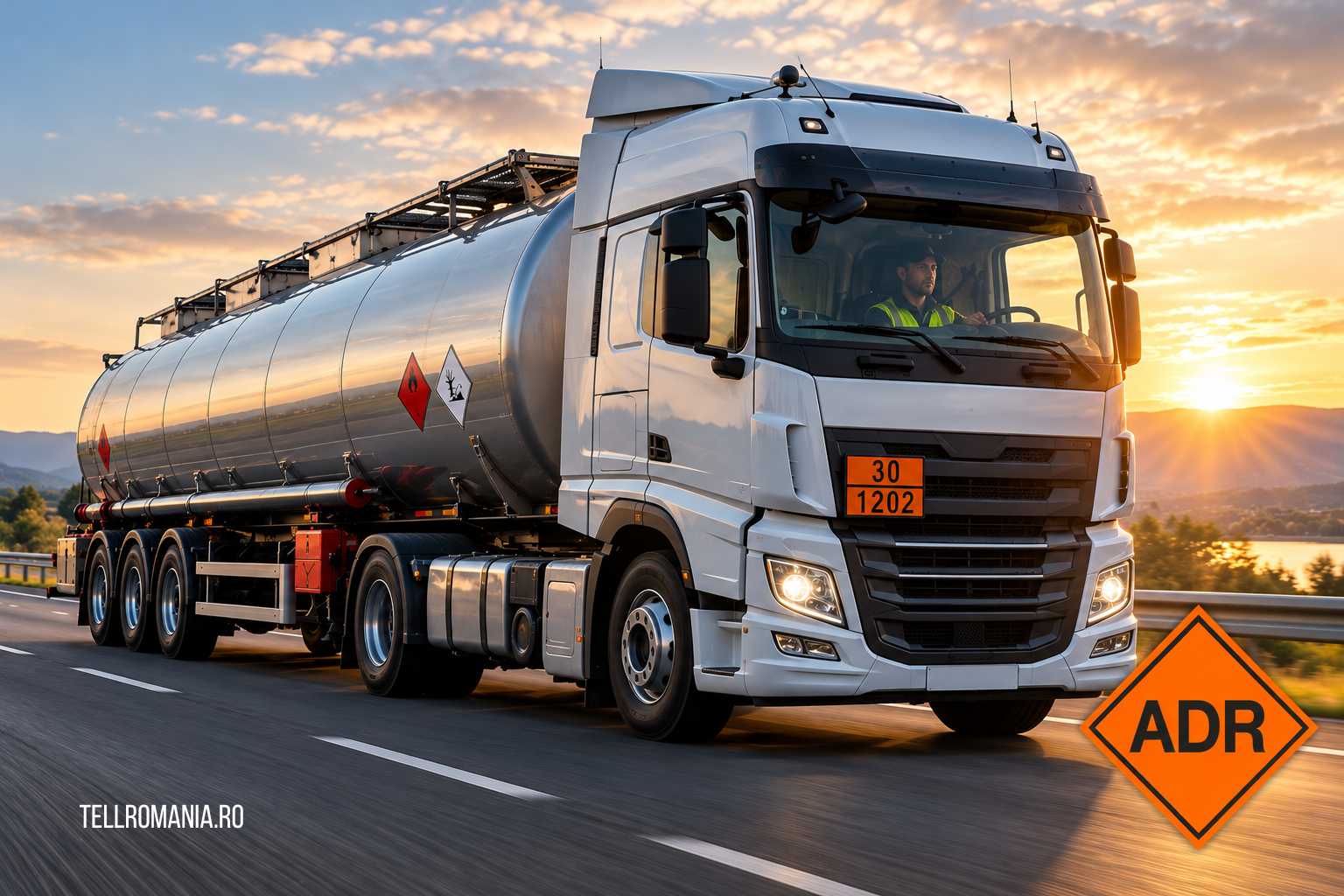
A new edition of ADR enters into force on 1 January 2027. The last implementation deadline is 1 July 2027. And for a fleet carrying dangerous goods, six months go by fast.
Why 1 July? ADR provides a six-month transitional period (1.6.1.1) during which carriage may continue under the ADR 2025 rules. From 1 July 2027, ADR 2027 becomes the only valid edition, and the old rules are no longer accepted at roadside checks.
ADR – the Agreement concerning the International Carriage of Dangerous Goods by Road – sets out how dangerous goods are classified, packed, labelled, documented and carried by road. All EU Member States apply it, including to domestic transport. In Romania, implementation and penalties are laid down in Government Decision (GD) No. 1175/2007.
The text is updated every two years. The 2027 edition does not overhaul the system, but it brings dozens of adjustments that reach the driver’s cab, the transport documents, vehicle equipment and company procedures. The most important concern batteries, the instructions in writing, driver training and the equipment of new vehicles.
ADR Annexes A and B
The ADR Agreement itself has only a few articles. The practical rules are in its two annexes, which make up the “ADR book” used every day by safety advisers, consignors and carriers. When people say “ADR is changing”, it is these annexes that change.
Annex A – the goods: what you carry and how you prepare it
It contains the general provisions and the provisions concerning dangerous substances and articles, organised in Parts 1–7:
- Part 1 – general provisions: definitions, exemptions (including the thresholds in 1.1.3.6), obligations of participants, staff training, transitional measures;
- Part 2 – classification: the 9 hazard classes and classification criteria;
- Part 3 – the Dangerous Goods List (Table A), with the UN number, label, hazard identification number and special provisions for each substance;
- Part 4 – packing and the use of tanks;
- Part 5 – consignment procedures: marking, labelling, orange plates, the transport document and the instructions in writing;
- Part 6 – construction and testing of packagings, receptacles and tanks;
- Part 7 – conditions of carriage, loading, unloading and handling.
Annex B – the vehicle and the transport operation
- Part 8 – vehicle crews, equipment, documents on board, driver training, supervision of vehicles;
- Part 9 – construction and approval of ADR vehicles (electrical equipment, braking, rear protection, FL, AT, EX/II, EX/III vehicles, etc.).
The 2027 edition amends both annexes. Batteries, orange plates and the instructions in writing fall under Annex A. Driver training, documents in the cab and the equipment of new vehicles fall under Annex B.
The amendments were adopted by the UNECE Working Party on the Transport of Dangerous Goods (WP.15) and notified to the Contracting Parties on 1 July 2026; the deadline for objections expired on 1 October 2026. The official text is UNECE document ECE/TRANS/WP.15/274.
At a glance: before and after
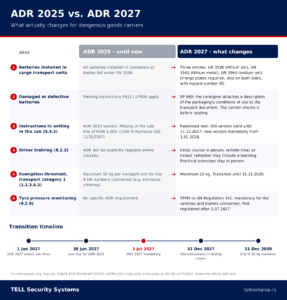
The six changes with a direct impact on carriers, and the transition timeline.
Key dates
- 1 January 2027 – ADR 2027 enters into force. The new rules may be applied from this date.
- 30 June 2027 – last day on which dangerous goods may still be carried under the ADR 2025 rules. Until then, a company may choose which edition to follow, but must apply it consistently.
- 1 July 2027 – ADR 2027 becomes the only valid edition, except for provisions with their own transitional periods.
- 31 December 2027 – last day for the old instructions in writing. From 1 January 2028, the new version must be in the cab.
- 1 January 2029 – vehicles first registered before this date may stay in service without the new rear protection (9.7.6).
- 31 December 2030 and 2034 – the longer transitional periods end: the exemption threshold for certain substances, salvage pressure receptacles, certain plastic drums and bulk containers.
Batteries: one entry becomes three
The biggest change concerns batteries installed in cargo transport units. These are containers, swap bodies or vehicle bodies in which the battery is part of the equipment – for example a container housing an energy storage system, or a unit with its own power supply. This does not cover batteries carried as goods in packages, nor the truck’s own battery.
Until now, all such units were assigned to UN 3536. From 2027, the entry is split by battery chemistry:
- UN 3536 – lithium ion batteries installed in a cargo transport unit;
- UN 3563 – lithium metal batteries installed in a cargo transport unit;
- UN 3564 – sodium ion batteries installed in a cargo transport unit.
Orange plates, including on the sides
Cargo transport units with such batteries must display orange plates on both sides, with the hazard identification number 90 at the top and the UN number at the bottom (for example 90 / 3536), except where the exemptions in 1.1.3.6 apply. For carriers, this means numbered plates in addition to the plain ones at the front and rear.
Hybrid and damaged batteries
- Special provision 410 – hybrid batteries combining lithium ion and sodium ion cells are assigned to UN 3480, 3481 or 3536. When carried under the small-battery exemption (SP 188), their rated energy may not exceed 100 Wh and must be marked on the outer casing.
- Special provision 680 – for damaged or defective lithium or sodium ion batteries packed under P911 or LP906, the consignor must give the loader and the carrier a description of the conditions under which the packaging may be used and carried. The description must be attached to the transport document.
A practical example: a carrier collects defective batteries from a repair shop for recycling. If the packaging is P911, the transport document must come with this description. Without it, the load should not be accepted.
One labelling detail: when a package needs both the battery mark and danger labels other than 9A, the mark must be placed on the same surface as the labels, if the package is large enough (5.2.1.9.3).
Labels and plates: a quick guide
Danger labels (the coloured diamonds) go on packages, containers and tanks and show the type of hazard. Orange plates go on the vehicle and the transport unit. A plain plate, without numbers, signals an ADR transport. A numbered plate shows the hazard identification number (top) and the UN number of the substance (bottom), so emergency services know straight away what they are dealing with.
Classes and labels do not change in ADR 2027. Lithium and sodium ion batteries still use label 9A. The guide below can be printed and given to dispatchers and drivers.
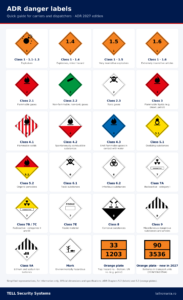
ADR danger labels and orange plates. Simplified representations, for information only.
Instructions in writing: what they are and what changes
The instructions in writing (ADR section 5.4.3) are a standard four-page document that must be in the cab of every ADR vehicle, within the driver’s reach. They tell the crew what to do in an accident or emergency.
What they contain
- Page 1 – general actions in an accident or emergency: stop the engine, avoid sources of ignition, warn other road users, alert the emergency services, keep away from the danger zone.
- Pages 2–3 – a table listing each danger label, what it means and what additional actions to take.
- Page 4 – special marks (environmentally hazardous, elevated temperature) and the mandatory equipment on board: wheel chock, warning signs, high-visibility vest, torch, gloves, eye protection and, for certain classes, an emergency escape mask, shovel, drain seal and collecting container.
Who is responsible
The carrier must provide the crew with the instructions before the journey starts, in a language each crew member can read and understand. The driver must know what goods are on board and consult the instructions before setting off.
What changes in 2027
The model stays the same, but the wording in the hazard tables is revised to describe the hazards more precisely. For example, for labels 2.1 and 3, “Risk of fire. Risk of explosion.” becomes “May cause fire. May cause explosion.”, and for Class 7 “Risk” becomes “Hazard”. In practice, every form printed today becomes outdated.
The old version may be used until 31 December 2027. From 1 January 2028, the new version must be in the cab. The official model is published on the UNECE website in the languages of the ADR Contracting Parties.
It is worth planning ahead: in Romania, missing or non-compliant instructions in writing, or instructions that do not match the goods carried, carry a fine of RON 5,000 to 7,000 (GD No. 1175/2007), applicable to the consignor and/or the carrier.
Documents in the cab
ADR 2027 clarifies that the mandatory documents must be kept “in the driver’s cab”. One practical novelty: a trailer’s ADR certificate of approval no longer needs to be in the cab, provided it is kept accessible in a safe place on the trailer, protected from the weather (8.1.2.2).
Driver training: online, but not entirely
ADR 2027 explicitly regulates digital courses and distinguishes between two formats:
- remote training – live teaching in which trainees and trainer communicate in real time from different locations;
- e-learning – self-paced modules, without a trainer in real time.
The rules by type of course:
- the initial course may be delivered in person, remotely or as a combination (8.2.2.4.3);
- the refresher course may also include e-learning, but the theoretical part may not be delivered entirely as e-learning (8.2.2.5.4);
- individual practical exercises must always be delivered in person;
- teaching units may be split into shorter sessions, and the competent authority has the right to access courses and examinations.
How these options apply in practice depends on the national competent authority – in Romania, the Romanian Road Authority (ARR) – so check with your training centre before planning 2027 sessions.
The scope of training also widens: Chapter 1.3 no longer refers only to employees, but to all persons participating in the carriage of dangerous goods. Training record-keeping obligations apply to them as well.
New vehicles: what to check when buying
- Tyre pressure monitoring (9.2.9) – ADR vehicles and trailers first registered after 1 July 2027 must have a TPMS complying with UN Regulation No. 141.
- Rear protection (9.7.6) – the rear bumper must comply with UN Regulation No. 58 (at least the 03 series of amendments), at a minimum of 150 mm from the rearmost part of the tank. Vehicles first registered before 1 January 2029 that do not comply may stay in service.
- Vehicles with camera monitoring systems (UN Regulation No. 46) must have an additional control device installed outside the cab (9.2.2.8.2).
- EX/III vehicles (explosives) – the thermal protection requirement for wheels is met by steel mudguards with steel mountings. Alternative solutions must withstand a tyre fire of at least 1,200 °C for 45 minutes (9.7.9.3).
Tanks, packagings and waste
- Orange band (5.3.5) – extra-large tank-containers for liquefied, refrigerated liquefied or dissolved gases must be marked with an unbroken orange band, about 30 cm wide, around the tank at mid-height.
- New section 6.9.3 – design, testing and marking requirements for fibre-reinforced plastic (FRP) service equipment of tanks.
- Empty uncleaned packagings (4.1.1.11.2) – drums and IBCs over 150 litres with residues that are hard to remove may be carried for disposal or recycling even if their period of use or inspection date has expired. Residues of high-risk classes (1, 2, 4.2, 4.3, 5.2, 6.2, 7), packing group I substances, asbestos and PCBs are excluded.
- Table A – four new UN numbers (UN 3561 and 3562 for chlorophenols, UN 3563 and 3564 for batteries), one deleted entry (UN 2941) and many amended entries.
Lower thresholds for some substances
Section 1.1.3.6 allows small quantities of dangerous goods to be carried under reduced requirements. For nine UN numbers in transport category 1 – including ammonia (UN 1005) and chlorine (UN 1017) – the maximum exempted quantity per transport unit falls from 50 kg to 20 kg. The transitional period runs until 31 December 2030. Companies that relied on this exemption should check whether they will need fully equipped ADR vehicles and certified drivers.
Checks are already stricter
Since June 2026, ADR roadside checks across the EU follow a single checklist. The most serious infringements can lead to the vehicle being immobilised. A missing document or a wrong plate is no longer a detail – it is a lost day on the road.
Checklist before 1 July 2027
- Map your battery transports. Check whether you carry units with installed batteries and which type they use: lithium ion, lithium metal or sodium ion.
Update the UN numbers in transport documents, in your transport management system (TMS) templates and in warehouse instructions. Responsible: the consignor. Checks: the carrier.
- Order the numbered orange plates. Units with installed batteries need 90 / 3536, 90 / 3563 or 90 / 3564 plates, including on the sides.
Also check your stock of plain plates for the front and rear.
- Replace the instructions in writing in every cab. Download the new official model in the languages of all your drivers and distribute it by 31 December 2027.
Keep a per-vehicle log so no cab still carries the old version in 2028.
- Agree with customers on damaged batteries. Set out in the contract who prepares the description required by SP 680 and how it reaches the carrier.
Train loading staff not to accept goods without this description.
- Update your training plan. Include the new rules in internal courses and check which formats (in person, online, mixed) your training centre accepts.
Extend training records to everyone involved in the operations, not only employees.
- Recheck your exemptions. If you carry ammonia, chlorine or other substances on the list of nine, recalculate quantities against the new 20 kg threshold.
- Check specifications when buying. New ADR vehicles first registered after 1 July 2027 need TPMS. Ask for confirmation in the offer.
- Review subcontractors and suppliers. Make sure the carriers you work with and your packaging and tank suppliers apply the same rules.
- Talk to your ADR safety adviser. Set the date when your company switches to ADR 2027 and update internal procedures.
Where GPS monitoring helps
ADR does not require a monitoring system. But a fleet carrying dangerous goods needs control, not guesswork.
With easyTRACK you know at any moment where each ADR vehicle is, which route it took and where it stopped. The full trip history backs you up with customers and supports you if an incident occurs. Zone alerts tell you immediately when a vehicle leaves its planned route. And for temperature-sensitive loads, easyTEMP records values throughout the journey.
The rules change every two years. The need to know what is happening to your cargo stays the same.
TELL Security Systems manufactures GPS fleet monitoring solutions in Brașov, Romania, with tens of thousands of units installed. Want to see what control looks like for your fleet? Contact us at tellromania.ro.
Sources: UNECE – ECE/TRANS/WP.15/274 (25 February 2026), official list of ADR 2027 amendments; ASTRA (Swiss Federal Roads Office) – commentary on the ADR 2027 amendments; Trans.info (6 October 2026); infotrucker.ro (15 October 2026); Romanian GD No. 1175/2007. This article is for information only and does not replace the official ADR text or the advice of an ADR safety adviser.